
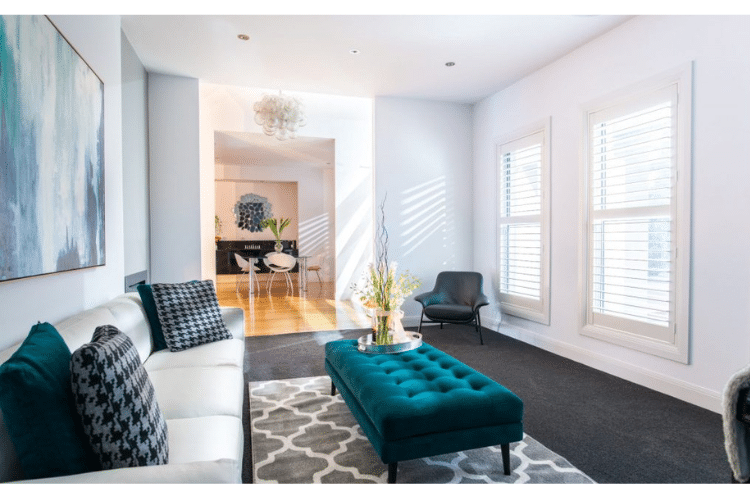
Stand in the doorway and watch where people walk. A curtain stack, a swinging shutter and a raised blind all leave different parts of the window clear. Choose the movement that works with the room.
A coordinated home does not require the same solution in every room. You might prefer adjustable blades in a living space, a soft curtain in a bedroom and a compact blind where a door opens close to the window. Start with the way each opening works, then select finishes that sit comfortably together. Fabric terminology is also covered in Fashionline’s fabric guide.
The case for shutters
An internal shutter has a frame and adjustable blades. Tilting the blades lets you alter the balance between light, outlook and privacy without raising the whole covering. The frame and opening panels need room, so check the swing and any handles or furniture nearby. Different materials have different care and suitability requirements. Ask about the exact product for a bathroom or another damp space rather than assuming all shutters behave alike.
The case for curtains
Curtains offer fabric texture and can be drawn back to expose the window. Consider how far the panels stack at the side: a track that extends beyond the opening may give a clearer view, but needs wall space. Lining and fabric affect light and privacy. Ask to see both sides of the proposed combination and check cleaning instructions before ordering. A sheer curtain by itself may not provide the evening privacy you expect.
The case for blinds
A roller blind can sit neatly at an opening. A Venetian blind offers tilting slats, while other designs fold or slide differently. Compare the mechanism as well as the fabric. A sunscreen fabric can retain a view in suitable daylight but may reveal a lit room after dark. A blockout fabric stops light through the fabric but may still leave gaps at the edges. Ask to see how the proposed mounting works around handles and reveals.
Walk through a room together
For a bedroom, describe your preferred darkness and how you use the window at night. Ask about edge gaps and whether a layered curtain-and-blind arrangement fits. In a living room, compare the outlook from your usual seat in daytime and the view in from outside after dark. At a sliding door, check that the selected covering can be moved clear of the doorway and is practical to operate every day.
Take photographs of each opening and note obstructions before a consultation. Ask for the quote to identify the product, fabric or material, mounting position and any lining, so the choices can be compared on the same basis.