
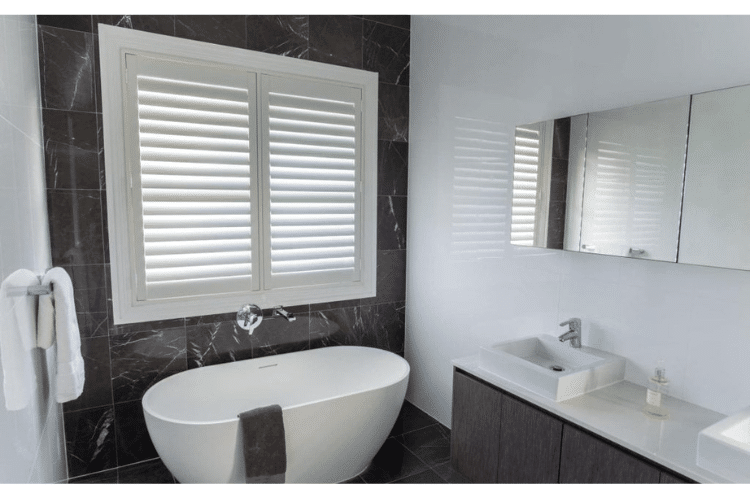
A laundry window above a trough gets different treatment from one beside a shower. Tell the supplier whether the covering will face steam, direct splashes or both, and check the hardware as well as the fabric.
This is general selection guidance for a humid room, including a Darwin bathroom or laundry. It is not a description of a particular member’s current products, and it does not rely on an older article for a universal material or treatment claim.
Describe the conditions accurately
A window next to a shower can experience direct splashes as well as humid air. A laundry window away from a sink may face a different combination of moisture and cleaning products. Tell the supplier where the window sits, whether it is regularly splashed, how the room is ventilated and whether the blind will be close to the glass. A photograph showing the opening and nearby fixtures is useful.
A blind is not a substitute for ventilation or for investigating an ongoing moisture problem. If moisture, mould or damage is already present, address the cause and seek suitable building or health advice before covering it. Do not assume a new blind or a fabric treatment will solve the underlying issue.
Compare the complete blind, not just the slat or fabric
Ask for the product’s written suitability and care information for the intended location. Does it cover humid air, direct splashes or both? What does it say about the headrail, fasteners, operating mechanism and any coating? “Moisture resistant” is not necessarily the same as suitable for repeated direct wetting. Avoid assuming that a material name alone tells you how the assembled product will perform.
A slatted blind lets you adjust the angle of the slats, but there are individual surfaces to clean and the headrail still needs consideration. A roller presents a different look and operating pattern, but the fabric, edges and mechanism all need to be appropriate to the conditions. Compare samples and the manufacturer’s instructions for the specific products rather than declaring one type universally best.
Check privacy without sacrificing practical access
If the window faces a neighbour or shared area, check the view from outside at the times the room is used. A light-filtering fabric can admit daylight, but that does not prove it conceals shapes or sightlines after dark. Ask about the effect of gaps at the edges and whether the window can still open and close comfortably.
Think about cleaning access too. Can you reach behind and around the covering without stretching over a bath or appliance? Can the window be opened for ventilation without the blind obstructing it? Ask for the recommended cleaning method and any products or tools to avoid. Follow the supplied instructions. Do not apply a coating, bleach or treatment on an assumption that it will prevent mould.
Take these questions to a supplier
- Is the whole product suitable for this window’s humidity and splash exposure?
- How should the material, fittings and controls be cleaned, and what should be avoided?
- How will the blind fit around handles, tiles and the opening window?
- What can be seen through or around it in the evening?
- What written care and warranty conditions apply to this installation?
For a local perspective, Straitline’s Darwin guide to made-to-measure blinds looks at choosing a covering for the opening. Describe any direct splashes when discussing materials.